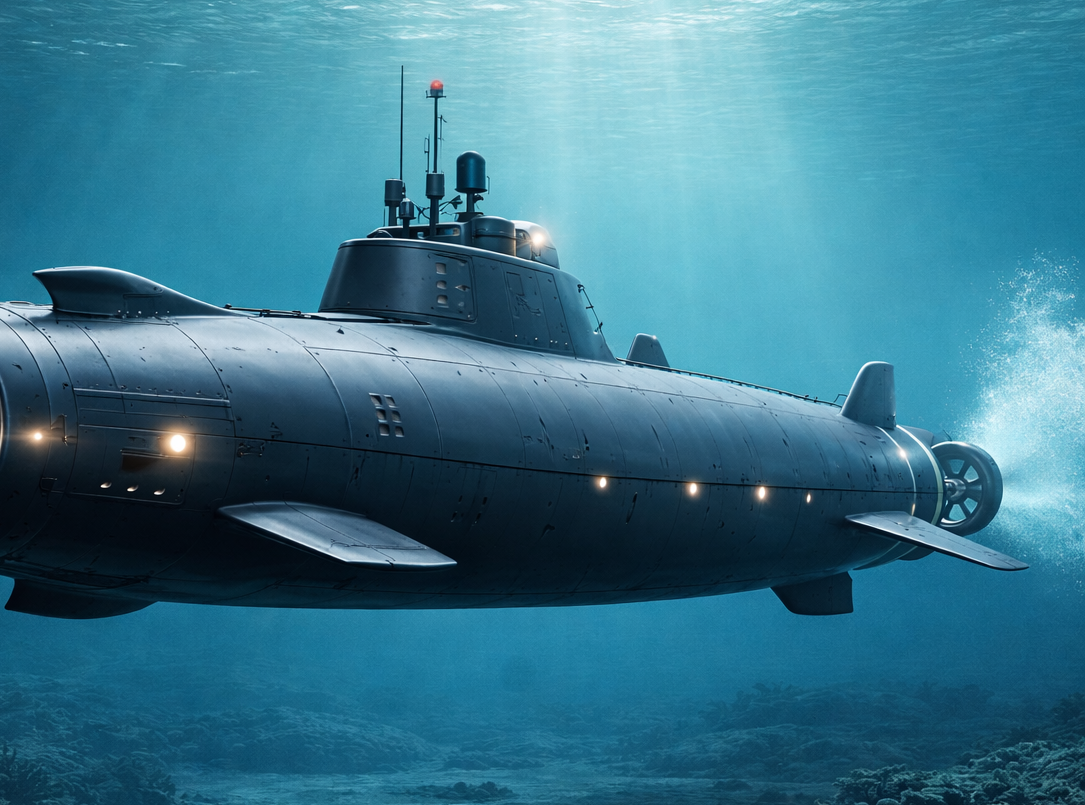
This paper defines the operational requirements and design parameters for a 60–100 ft hybrid hydrogen-powered mini submarine capable of diving to 500 feet for research and tactical defense missions. Drawing lessons from recent commercial submersible failures, the design prioritizes proven steel or aluminum pressure hull construction, redundant dual power architecture, and conservative safety margins. A neutrally buoyant, hydrodynamically optimized hull with fish-like control surfaces enhances maneuverability and efficiency. Integrated acoustic and thermal stealth features reduce detectability. Modular logistics enable global deployability by trailer, ship, or heavy air transport. The result is a compact, survivable, and versatile operational submarine platform.
This innovation combines three breakthrough technologies: interlocking concrete blocks with puzzle-like precision joints, mobile on-site manufacturing units that eliminate material transport, and robot-compatible design enabling full automation. The system requires only two trucks—one carrying raw materials, another housing manufacturing equipment—to produce standardized blocks at the construction site. Each block features integrated grip points for robotic handling and precise interlocking mechanisms that eliminate traditional masonry skills. This convergence of modular design, distributed manufacturing, and automation promises to dramatically reduce construction time, labor costs, and material waste while improving structural accuracy and consistency across residential, commercial, and emergency construction applications.
Modern airports suffer from chaotic baggage handling, congested passenger flows, and inefficient plane servicing. This paper proposes a comprehensive redesign addressing three critical areas: First, intelligent baggage tracking using AirTag technology that directs passengers to numbered carousel positions, eliminating the frantic circling of claim areas. Second, fully automated baggage transport systems replacing manual handling with mobile robotics feeding directly into aircraft Unit Load Devices (ULDs). Third, multi-tier passenger boarding infrastructure that physically separates arriving, departing, and connecting passengers, preventing bottlenecks and reducing the collision points that create current airport congestion. Together, these innovations promise dramatic improvements in efficiency, passenger experience, and operational reliability.
This paper proposes a novel symmetric air-launch architecture for suborbital and orbital payload delivery, consisting of two aerodynamically symmetric aircraft halves integrated along a horizontal centerline during ascent. The combined vehicle operates as a single aircraft during takeoff and climb. At a predetermined altitude and flight condition, the system separates into upper and lower vehicle halves, each performing distinct mission roles. The lower vehicle transitions into a rocket-powered spaceplane and ascends to space with payload, while the upper vehicle—having expended the majority of its fuel during ascent—returns to base. The concept builds upon air-launch and benign reentry principles demonstrated by Burt Rutan, while introducing a vertically symmetric, separable airframe not previously fielded.
This paper examines Formula 1's abandonment of MGU-H exhaust heat recovery technology, analyzing the mechanical, financial, and expertise challenges that led to its removal. Despite F1's retreat, the paper proposes redirected research pathways including simplified thermoelectric systems, heavy-duty vehicle applications, advanced materials development, and AI-driven optimization to make waste heat recovery economically viable for real-world applications.