
When you compare population trajectories from 1945 to 2025 across Russia, China, India, and the United States, you’re not just looking at statistics—you’re seeing the physical embodiment of national choices, historical traumas, and development priorities. The numbers reveal which countries invested in their people and which squandered their demographic potential.
The Raw Numbers
This is the comparison in stark terms:
Russia:
- 1945: ~97 million (post-war devastation)
- 1950: ~103 million
- 2025: ~144 million
- Growth: 48% over 80 years
China:
- 1949: ~542 million
- 1950: ~544 million
- 2025: ~1,405 million
- Growth: 159% over 76 years
India:
- 1950: ~359 million (using 1951 census as proxy for 1945)
- 2025: ~1,464 million
- Growth: 308% over 75 years
United States:
- 1945: ~133 million
- 2025: ~342 million
- Growth: 157% over 80 years
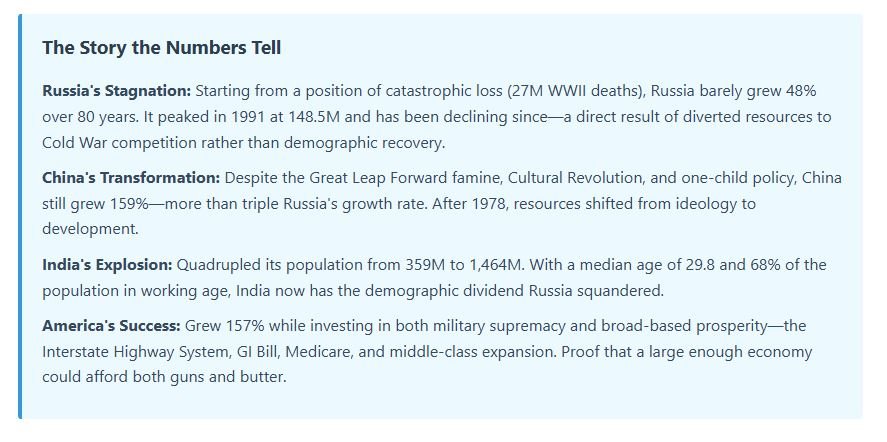
Look at those growth rates. India more than quadrupled its population. China and the United States increased by roughly 2.5 times. And Russia? Barely grew by half. Russia’s population in 2025 is only 48% larger than it was when the war ended, and much of that growth came in the immediate post-war years. In fact, Russia’s population peaked at 148.5 million in 1991 World Population Review, meaning it has actually declined over the past 34 years.

What the Numbers Mean
This isn’t just about birth rates or death rates in isolation. This is about what happens when a nation loses an entire generation to war and then immediately diverts what resources it has left into an arms race rather than reconstruction and human development.
Consider what Russia faced in 1945. The population of the Russian Soviet Republic reached only 97 million in 1946 and didn’t hit 100 million until 1949 TASS. The demographic structure was catastrophically distorted—massive gender imbalances, missing age cohorts, a hollowed-out reproductive base. To recover from this, Russia needed several things: peace, resources invested in families, housing, healthcare, and an environment where people felt secure enough to have children.
It got none of these things.
Instead, the Soviet Union spent the next 45 years maintaining a massive military, occupying Eastern Europe, fighting proxy wars, and trying to match American defense spending with an economy one-third the size. By the 1980s, although the Russian demographic situation remained stable with fertility reaching 2.23 by 1987, the 1990s saw another demographic crisis TASS. Then came the catastrophic 1990s—economic collapse, plummeting life expectancy, and a population decline that continues today.
The China Comparison
Now look at China. Yes, China also suffered enormously in World War II—estimates suggest 15-20 million Chinese died during the war with Japan. But China’s demographic recovery trajectory was radically different from Russia’s.
Starting from approximately 542 million in 1949, China’s population reached 1,412.6 million people by 2021 CEIC Data, before beginning a slight decline. That’s a 2.6x increase despite the one-child policy that was in effect from 1979 to 2015, despite the catastrophic Great Leap Forward (1958-1962) that caused perhaps 30 million deaths from famine, despite the Cultural Revolution (1966-1976).
How did China achieve this while Russia stagnated? Several factors: China didn’t face the same level of proportional wartime devastation as Russia—27 million dead out of 170 million is far more catastrophic than 15-20 million out of 540 million. China, after Mao’s death in 1976, pivoted away from ideology toward economic development. China became a manufacturing powerhouse and began investing massively in infrastructure, cities, education, and healthcare. By the 1980s and especially the 1990s, China was building modern cities, highways, high-speed rail, and creating an environment where—despite the one-child policy—people could imagine prosperous futures.
Russia never made that transition. Even after the Cold War ended, Russia in the 1990s experienced chaos rather than development, oligarchy rather than broad-based prosperity.
The India Phenomenon
India’s numbers are even more striking. From roughly 359 million in 1950 to 1,464 million in 2025—a quadrupling of the population. Since 1970, India’s population has more than doubled from 545.9 million to 1,463.9 million Populationpyramids.
India didn’t suffer the massive wartime casualties that Russia and China did. India gained independence in 1947 and immediately began investing in its future—universities, the IIT system, democratic institutions, and eventually economic liberalization. Yes, India has massive poverty and development challenges, but it created an environment where families could grow. Key factors include improved healthcare reducing infant and maternal mortality, better nutrition and sanitation, and economic development supporting larger families Populationpyramids.
Most significantly, India is now reaping a demographic dividend. The median age in India is approximately 29.8 years as of 2024, compared to 40.2 in China, with 68% of the population between 15 and 64 years old, creating a potential demographic dividend Wikipedia. India has a young, growing workforce entering its most productive years. Russia has an aging, shrinking population with a median age over 40 and more deaths than births.
The American Exception
The United States is the anomaly here—a country that emerged from World War II with its homeland untouched, its economy booming, and positioned to dominate the post-war world. From 133 million in 1945 to 342 million in 2025, the US grew 2.6 times—similar to China but without China’s draconian population controls.
Why did America grow so successfully? Because it invested in both guns and butter. The United States built the Interstate Highway System, expanded higher education massively through the GI Bill, created suburbs and housing for returning veterans, developed Medicare and Social Security, and presided over the greatest expansion of middle-class prosperity in human history. All while maintaining the world’s most powerful military.
The crucial difference: America could afford it. The American economy was large enough, dynamic enough, and productive enough to support both military supremacy and broad-based social investment. Russia couldn’t do both, chose the military, and its people paid the price in demographic stagnation.
The Russian Paradox in Numbers
This brings us back to your original insight about the Russian Paradox. Russia lost 27 million in World War II—possibly another 6-9 million (or more by some estimates) to Stalinist terror. Starting from this catastrophically weakened demographic position, Russia then spent every available resource on the Cold War rather than on creating an environment where families could thrive.
The result? Russia’s current population is 143,522,442 as of early 2026, with the population density at just 9 per square kilometer Worldometer. For comparison, India’s population density is 497 per square kilometer, China’s is 150, and even the sprawling United States has 37 per square kilometer.
Russia has the world’s largest land area but one of its smallest population densities. This isn’t because Russians prefer open spaces—it’s because the country never demographically recovered from the combined catastrophes of World War II and the Cold War. Russia currently has a fertility rate of 1.41 children per woman in 2024, well below the replacement level of 2.1 Populationpyramids. The population is declining, aging, and there’s no realistic path to reversal.

What Might Have Been
Imagine if Russia, in 1945, had made different choices. Imagine if the resources spent on ICBMs, nuclear submarines, occupying Eastern Europe, and fighting in Afghanistan had instead gone into building modern cities, transportation networks, hospitals, schools, and creating an environment supportive of families.
Would Russia have 200 million people today? 250 million? With a stable demographic structure and a young workforce, would Russia be an economic powerhouse rather than a petro-state? We’ll never know. But the comparison with India is instructive—India started with 359 million in 1950 and now has 1,464 million. Not because Indians are culturally programmed to have large families, but because India created conditions where population growth occurred naturally.
Russia could have recovered. The Russian people are educated, talented, resilient. But they were never given the peace, resources, and stability needed to rebuild after the catastrophe of World War II. Instead, they were immediately thrust into another 45-year struggle that consumed everything.