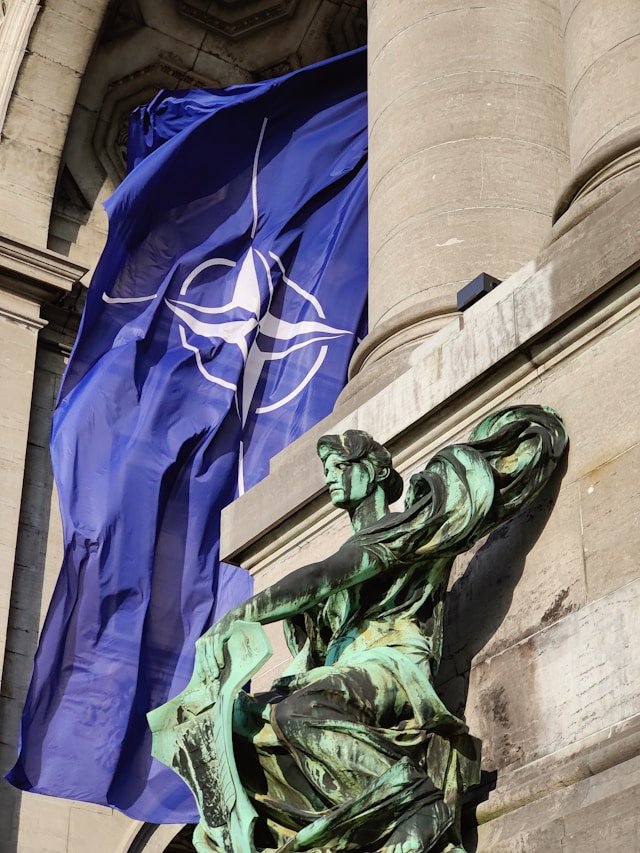

Perhaps the most fundamental challenge to NATO’s survival concerns something rarely discussed in policy circles: the alliance was built on an assumption of shared peoplehood that no longer exists.
The Original Anglo-Saxon Compact
NATO’s founding logic wasn’t merely about abstract democratic values or geopolitical interests—it rested on something deeper and more primal: kinship. When the alliance formed in 1949, the dominant American population traced its ancestry directly to the very European nations the treaty obligated them to defend. British, German, Irish, Italian, Scandinavian—these weren’t foreign peoples to most Americans. They were cousins, aunts, uncles. The villages their grandparents left a generation or two prior.
This wasn’t incidental to NATO’s political viability. American soldiers crossing the Atlantic weren’t defending strangers—they were protecting their ancestral homelands. The “Greatest Generation” that liberated Europe in World War II often had direct family memories of the old country. NATO formalized what felt natural: protecting your own people.
The Public Repudiation
Then came a series of moments that revealed how thoroughly this foundation has crumbled.
When Donald Trump ran for president, his ancestral village of Kallstadt, Germany—the town his grandfather left in 1885—publicly declared themselves “ashamed” of their connection to him. Here was an American president with direct, traceable lineage to a German town, and rather than pride in their diaspora descendant rising to the world’s most powerful office, they expressed embarrassment and rejection.
Even more striking was the moment at the 2018 NATO summit when Trump warned European leaders about their dangerous energy dependence on Russia. The response? Open laughter. Not polite diplomatic demurral, but visible mockery of an American president attempting to warn Europeans about their strategic vulnerability. The prediction, of course, proved prescient when Russia invaded Ukraine and Europe faced an energy crisis—but that’s almost beside the point.
The point is this: the president of the United States—the nation providing the vast majority of NATO’s actual military power—was laughed at by the very people American forces are treaty-bound to defend.
The Demographic Transformation of America
The ancestral bond weakens from the American side as well. According to U.S. Census data, the demographic composition of America has shifted dramatically. The percentage of Americans claiming exclusively European ancestry has declined significantly, while Hispanic, Asian, and African ancestry populations have grown substantially.
By mid-century, demographic projections suggest that Americans of European descent will no longer constitute a majority. Already, among younger age cohorts, this shift is well advanced. The children who will be asked to fight future wars have increasingly distant—or nonexistent—connections to Europe.
Why would a third-generation Mexican-American from Texas feel a natural affinity to defend Estonia? What ancestral pull would motivate a Chinese-American from California to risk death protecting Poland? These aren’t questions about patriotism or military professionalism—American service members will follow orders regardless. These are questions about the political sustainability of alliance commitments among the civilian population that must support such wars.
The Death of Trans-Atlantic “Peoplehood”
Kallstadt’s rejection of Trump and European leaders’ open mockery at NATO summits represent something profound: the mutual recognition that Americans and Europeans no longer see each other as kin.
Europeans, having consciously chosen demographic transformation through immigration and having cultivated a post-national European identity, no longer view Americans—especially conservative Americans—as “their people” in any meaningful sense. The cultural and political gulf has become a chasm. To many Europeans, Americans are no longer distant cousins to be protected but increasingly alien others whose politics they find incomprehensible and whose cultural values they reject.
From the American side, generations of Europeans who treat their American relatives with contempt, who mock their concerns, who express shame at family connections—these are not bonds that inspire sacrifice. The natural affinity that made NATO intuitive to earlier generations simply doesn’t exist for millions of younger Americans whose ancestors never set foot in Europe, or whose European-descended ancestors have been told they are unwelcome embarrassments to their ancestral villages.
The Alliance Without Affinity
This is NATO’s existential crisis, stripped to its core: an alliance premised on shared peoplehood between populations that increasingly share neither ancestry nor affinity.
The policy papers speak of “shared values” and “democratic principles,” but these abstractions cannot substitute for the ancestral bonds that made the original commitment sustainable. Values are contested and change. Blood ties—at least the perception of them—created visceral, emotional commitment.
When the American soldier in 1950 imagined defending Norway, he might well have been imagining the village his grandmother left, protecting people who looked like his family, spoke a language he heard growing up. When an American soldier in 2050 imagines defending Norway, what will he see? A wealthy, foreign country that has expressed contempt for his nation, populated partly by his distant European cousins (if he has any) and partly by recent immigrants from entirely different continents.
And from the Norwegian side? They see American soldiers not as heroic cousins coming to their aid, but as representatives of a trigger-happy, culturally alien power that they increasingly neither understand nor respect.
The Foundation Has Cracked Beyond Repair
You can rebuild strategy. You can reform institutions. You can renegotiate treaties.
But you cannot rebuild a foundation of shared peoplehood once it has been deliberately dismantled by both parties.
Europe chose post-nationalism and demographic transformation. America became the genuinely multiracial, multi-ethnic society it long claimed to be. These were choices, and they have consequences.
One consequence is this: the ancestral bedrock on which NATO was built no longer exists. An alliance between peoples who viewed each other as kin has become a transactional arrangement between increasingly alien parties, one of whom (Europe) openly mocks the other (America) while depending entirely on that other for its defense.
Kallstadt’s shame and the laughter at NATO summits aren’t diplomatic faux pas. They’re symptoms of alliance death—the moment when the foundations prove to have already crumbled, even as the superstructure still stands.
The question isn’t whether NATO can survive this. The question is why anyone thinks it already has.