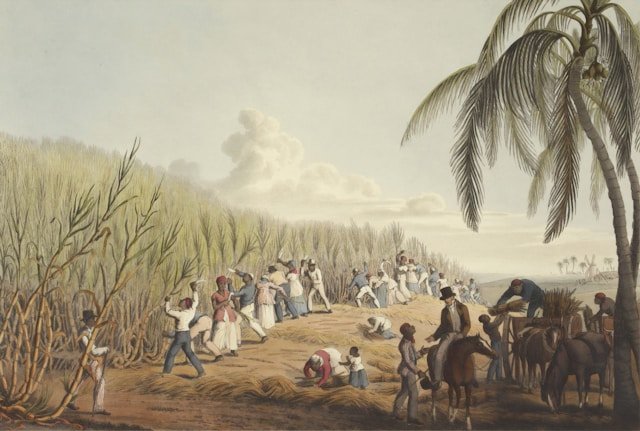

In 1834, Britain abolished slavery across its empire. It was heralded as a moral triumph, a civilisational milestone, the culmination of decades of abolitionist struggle. What followed, however, was not freedom but substitution. Within months of emancipation, the colonial plantation economy — built on coerced labour and the ruthless extraction of agricultural wealth — began casting about for a replacement workforce that was equally controllable, equally cheap, and equally expendable. It found one in India.
Over the next eight decades, more than two million men, women, and children from the Indian subcontinent were transported under contract to sugar colonies, railway projects, and agricultural estates across the Global South. They went to Trinidad and Tobago, British Guiana, Natal in South Africa, Fiji, Mauritius, Jamaica, Kenya, Uganda, Malaya, and Ceylon. They were recruited — frequently through deception — from the impoverished rural districts of Uttar Pradesh, Bihar, and Tamil Nadu, loaded onto ships for voyages that could last months, and delivered into conditions that one historian would later call, without exaggeration, a new system of slavery [1]. They were known as Girmityas, a corruption of the word “agreement” — the indenture contract they had signed, often without understanding its terms, in exchange for passage and the promise of wages.
This paper examines the Indian indentured labor system within the framework of British imperial political economy. It asks four questions. First, why did the system emerge when and where it did? Second, how was it operationalized — through what mechanisms of recruitment, transportation, legal coercion, and plantation discipline? Third, what happened to those who survived it: how did they resist, adapt, and rebuild lives in countries they had never chosen to inhabit? And fourth, how does the world reckon with this history today — or, more precisely, why has it largely failed to do so?
The indentured labour system occupies an uncomfortable gap in the collective memory of empire. It is too recent to be comfortably distant, too large in scale to be called incidental, and too systematic to be dismissed as the excess of individual actors. It sits awkwardly between the acknowledged horror of the transatlantic slave trade and the romantic mythology of voluntary migration — belonging fully to neither, and therefore often falling through the cracks of both historical scholarship and contemporary reparative justice. The descendants of indenture — Indo-Trinidadian, Indo-Guyanese, Indo-Fijian, Indo-South African — built nations, shaped cultures, and produced political leaders of historic significance, all while carrying a foundational wound that has never formally been acknowledged by the state that inflicted it.
To tell this story is not merely to recover a buried history. It is to insist that the full moral accounting of the British Empire remains, more than a century after indenture ended, unfinished.
1. Why It Happened — The Economic Logic of Empire
The Indian indenture system was a system of indentured servitude by which more than 1.6 million workers from British India were transported to labour in European colonies as a substitute for slave labour, following the abolition of the trade in the early 19th century [1]. The core economic driver was brutally simple: after the abolition of slavery, newly freed men and women refused to work for the low wages on offer on sugar farms in British colonies in the West Indies [2]. Planters needed a replacement workforce that was cheap, controllable, and contractually bound.
From 1834 to the end of WWI, Britain transported about 2 million Indian indentured workers to 19 colonies including Fiji, Mauritius, Ceylon, Trinidad, Guyana, Malaysia, Uganda, Kenya and South Africa [2]. The system was explicitly designed to mimic the economic benefits of slavery while providing legal cover as “free” labour. The Imperial Legislative Council finally ended indenture because of pressure from Indian nationalists and declining profitability, rather than from humanitarian concerns [1].
2. How It Worked — Recruitment, Deception, and the Crossing
Commonly referred to as “Girmityas,” most labourers came from Uttar Pradesh, Bihar, and Tamil Nadu — individuals from poor and rural backgrounds who signed contracts to work abroad for a fixed period in return for free passage, food, and shelter [3].
The recruitment process was systematically dishonest. It was common for recruiters to lie about the type of work and the amount of pay involved [4]. Given high levels of illiteracy, few workers understood the terms of the contract they put their thumb imprint to. Many were commonly misled about where they were departing for and the wages they would receive — recruited from rural India to work in cities like Calcutta, then tricked or persuaded to sign contracts that took them to emigration depots and overseas plantations [2].
Although described by colonial authorities as “free” migration, many recruits were deceived, coerced, or kidnapped, leading historians such as Hugh Tinker to characterise the system as a “new form of slavery” [1].
The voyages themselves were lethal in the early period. On some ships, mortality rates exceeded 17%, largely due to cholera, dysentery, overcrowding, and poor rations. Frequent outbreaks of disease and cases of suicide among labourers generated public outcry in Britain and India [1].
3. Conditions of Labour — The Plantation Reality
Life for indentured labourers was gruelling. They worked long hours in sugarcane fields, often under oppressive conditions. The promises made by British recruiters rarely matched the reality [5]. The contracts were part of a continuum of unfreedoms within capitalism, ranging from labour relations with some violations of workers’ rights to those that could be classified as severely exploitative and abusive [6]. A Methodist missionary in Fiji in 1910 concluded that the difference between indenture and slavery was “merely in the name and term of years,” and that labourers themselves frankly called it “narak” — hell [7].
Between 1895 and 1902, several thousand Indian indentured labourers helped build the Kenya-Uganda Railway. An estimated seven percent of those workers died during their contract, and man-eating lions attacked the rail construction brigades on several occasions, killing around one hundred workers [2].
4. Resistance — They Were Not Passive Victims
Migrant workers did try to oppose the abuses of the indentured labor system. Some sent petitions to colonial government agents. According to historical records, indentured workers carried out acts of sabotage and revenge against plantation owners on numerous occasions, but this just resulted in increased repression [2]. Forms of resistance included cultural retention, escapism, legal action through limited available channels, and strikes and uprisings, though these were often met with harsh retaliation [8].
A notable flashpoint was the 1884 Hosay Massacre in Trinidad, when colonial troops fired on a Hosay procession after the crowd refused to disperse before entering San Fernando — twelve indentured workers were killed and around a hundred wounded [9].
External pressure also mounted. Mahatma Gandhi saw firsthand the plight of Asian indentured labourers in South Africa and campaigned on this issue during the first decade of the 20th century [2]. Gopal Krishna Gokhale tabled a bill in the Viceroy Legislative Council to end the export of indentured labour to Natal in February 1910, which passed unanimously and came into effect in July 1911 [1]. The system for other colonies ended in 1917.
5. After Freedom — Coping, Adapting, and Moving On
Staying put: Most never returned to India, despite their right to a free passage on completion of their indenture and a period of residence in the colony [4]. Many women who had left India after family disagreements were unlikely to be accepted back home after years abroad. By this point, many had already laid down roots in their new countries, choosing to stay and build new lives [5].
Land acquisition as strategy: Indo-Trinidadian rural life — stigmatized by rhetoric of backwardness and cultural insularity — structured the indentured workers’ and their descendants’ relationship with land. Communal living allowed a semblance of cultural continuity with the homeland, while rural land possession became a marker of stability and an opportunity for lower-caste groups to rewrite their fate [10].
Cultural survival: Workers found ways to resist and preserve their cultural identity through informal support networks and maintained cultural practices such as Hindu and Muslim religious observances, festivals, and traditional music. These practices provided a sense of solidarity and laid the foundations for the Indo-Caribbean, Indo-Mauritian, Indo-Fijian, and Indo-South African communities that exist today [1].
Political rise: Individuals of Indian origin began to enter politics, trade unions, academia, and journalism, asserting their presence in public life [3]. Cheddi Jagan, a key figure in the Guyanese independence movement, was himself the child of indentured Indian workers [9].
Secondary migration to Britain: Over the following century, descendants of those who stayed became significant parts of the population of countries including Guyana, Suriname, Trinidad, Jamaica, Malaysia and South Africa. Many of these people later migrated to the UK in the 1950s and thereafter, effectively becoming part of the Windrush generation, though their indenture roots are far less recognized in that narrative [2].
6. Reparations — The Ongoing Silence
No formal apology has been offered for the system of indenture — unlike the Holocaust or the Transatlantic slave trade, it remains largely unacknowledged at a state level [11]. CARICOM previously set out formal demands in a 10-point plan detailing why and in what form slavery reparations should be given, from apologies to payments and debt cancellations, and this list is currently being updated to include indentured labor [12]. President Ali of Guyana — a country where more than 200,000 East Indian laborers went under the indenture system and whose largest ethnic group today (39%) is of Indian descent [12] — has stated that nations which benefited from these systems need to “do the morally right thing.”
David Cameron ruled out reparations in a 2015 visit to Jamaica, and Rishi Sunak rejected calls for reparative payments in 2023 [12]. The financial scale is part of the problem: scholars who have attempted to calculate a fair sum have arrived at a figure so astronomical — three trillion pounds in today’s money — that no one could reasonably be expected to pay it, a sum larger than Britain’s entire GDP [13]. This has led figures like Shashi Tharoor to call instead for formal apologies and curricular reform rather than financial settlement.
References
[1] Wikipedia. Indenture system in the British Empire. Wikimedia Foundation. https://en.wikipedia.org/wiki/Indenture_system_in_the_British_Empire
[2] Glendinning, L. “A new system of slavery”: the story of Indian indentured labour in the British Empire. The Guardian. https://www.theguardian.com/world/2022/sep/30/a-new-system-of-slavery-the-story-of-indian-indentured-labour-in-the-british-empire
[3] Mukherjee, B. The Indentured and Their Route. Ministry of External Affairs, Government of India / UNESCO Memory of the World Register. (2023)
[4] National Archives of Trinidad and Tobago / Colonial Office Records. Recruitment and indenture documentation, 1838–1917.
[5] Ramesar, M. Survivors of Another Crossing: A History of East Indians in Trinidad 1880–1946. University of the West Indies Press. (1994)
[6] Lal, B.V. Girmitiyas: The Origins of the Fiji Indians. Journal of Pacific History / Australian National University. (1983)
[7] Burton, J.W. Fiji of Today. Epworth Press, London. (1910) [Methodist missionary account cited in Lal (1983)]
[8] Shepherd, V. Maharani’s Misery: Narratives of a Passage from India to the Caribbean. University of the West Indies Press. (2002)
[9] Ramnarine, T.K. Creating Their Own Space: The Development of an Indian-Caribbean Musical Tradition. University of the West Indies Press. (2001)
[10] Munasinghe, V. Callaloo or Tossed Salad? East Indians and the Cultural Politics of Identity in Trinidad. Cornell University Press. (2001)
[11] Tharoor, S. Inglorious Empire: What the British Did to India. Hurst & Company. (2017)
[12] The Telegraph. CARICOM reparations demands to include Indian indentured labour. (2024)
[13] Tharoor, S. Address to the Oxford Union debate on British colonial reparations. (2015); see also Patnaik, U. Recalculating the British drain of wealth from India in Chavan & Krishnaswamy (eds.), Agrarian and Other Histories. Tulika Books. (2017)