
What does it mean to be a democracy? Is the biggest the best — like India, the world’s most populous, with over a billion votes cast in a single election? Is the richest the best — like America, whose economic might funds institutions that other nations can only aspire to? Or is the smallest the best — like Switzerland, where direct democracy is not an ideal but a daily practice?
These are obvious questions, but they are simple ones too. Size brings scale but not always depth. Wealth builds courts and polling stations but cannot buy the will to use them honestly. Smallness creates intimacy but not immunity — small nations can be captured just as completely as large ones. The measure of a democracy is not found in any of these dimensions alone.
What follows are three foundational traits — not exhaustive, but essential. They are the floor, not the ceiling. A country that cannot meet these three conditions is not yet a democracy, whatever it calls itself. A country that meets all three is building something worth defending.
The Sacred Ballot — One person, one vote
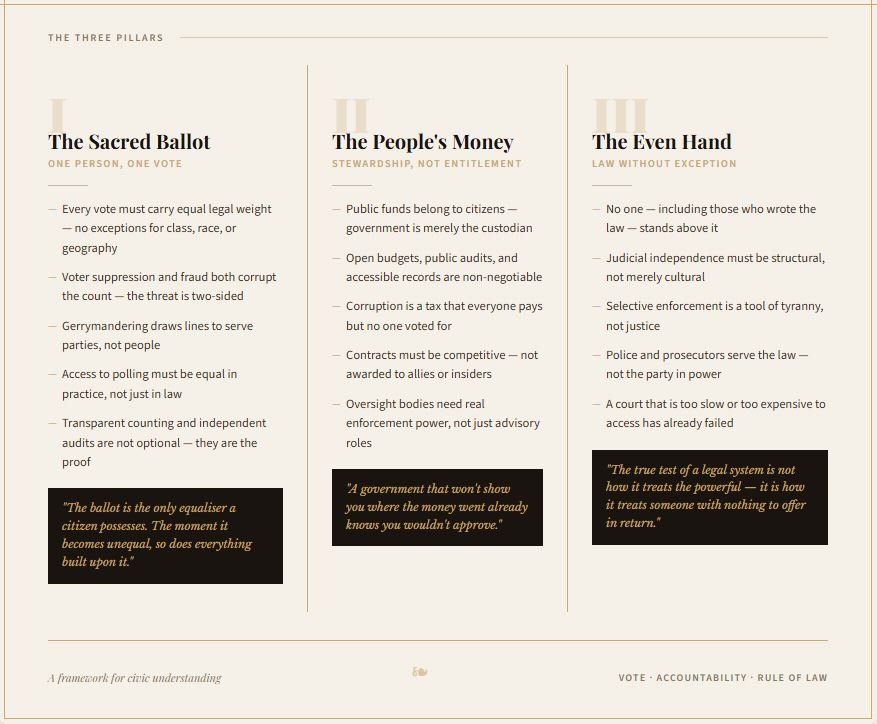
The vote is the foundational transaction of democracy. Every distortion of it — whether through suppression, fraud, or manipulation of district lines — chips away at the legitimacy of everything built on top of it. The key tension here is that both over-restriction (making it hard for eligible people to vote) and under-restriction (allowing ineligible votes or duplicate votes) damage the system. The goal is a vote that is easy to cast, hard to abuse, and impossible to deny based on who you are.
Key talking point: “The integrity of an election isn’t measured only by whether fraud is prevented — it’s also measured by whether every eligible citizen can actually participate.”
The People’s Money — Stewardship, not entitlement
Government spending is the most visible expression of a democracy’s priorities. When public funds are wasted, misdirected, or stolen, citizens lose the tangible return on the social contract. Accountability here isn’t just about catching corruption after the fact — it’s about building systems where corruption is structurally difficult in the first place: open bidding, independent auditors with enforcement power, mandatory public disclosure.
Key talking point: “A government that won’t show you where the money went is a government that already knows you wouldn’t approve.”
The Even Hand — Law without exception
Rule of law means the rules apply equally to the person writing them and the person subject to them. This requires three things working together: an independent judiciary that can’t be pressured by the executive branch, law enforcement that serves the law rather than the party in power, and a court system that is actually accessible to ordinary people. Justice that only functions for those with resources or connections is not justice — it is a performance of it.
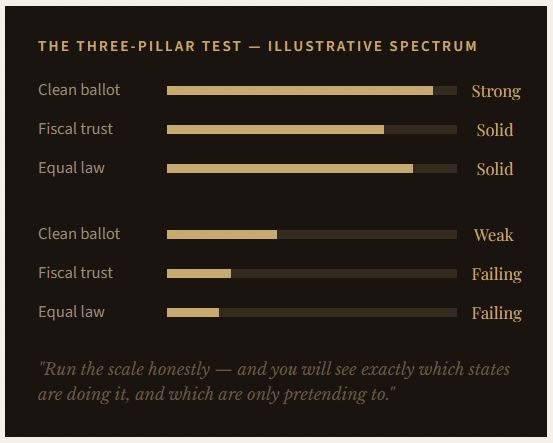
Now take these three pillars and apply them as a measuring stick — run them across every nation that calls itself a democracy — and something uncomfortable emerges. The rankings we assume are not always the rankings we find.
A wealthy country with compromised courts scores below a modest one where the law is genuinely blind. A large, boisterous democracy with rigged district lines ranks beneath a quieter state where every vote lands with equal weight. A nation with gleaming institutions and a hollowed treasury fails the test that a smaller, poorer neighbour passes with ease.
The scale reveals what the labels conceal. States that are succeeding on all three pillars tend to be trusted by their own people — not because they are told to be, but because trust has been earned repeatedly, in small acts of institutional honesty. States that are failing tend to compensate with noise: nationalism, spectacle, and the performance of strength in place of its substance.
Apply the scale honestly, and you will see clearly. The question was never which democracy is biggest, richest, or oldest. The question has always been: which ones are actually doing it?