
Summary
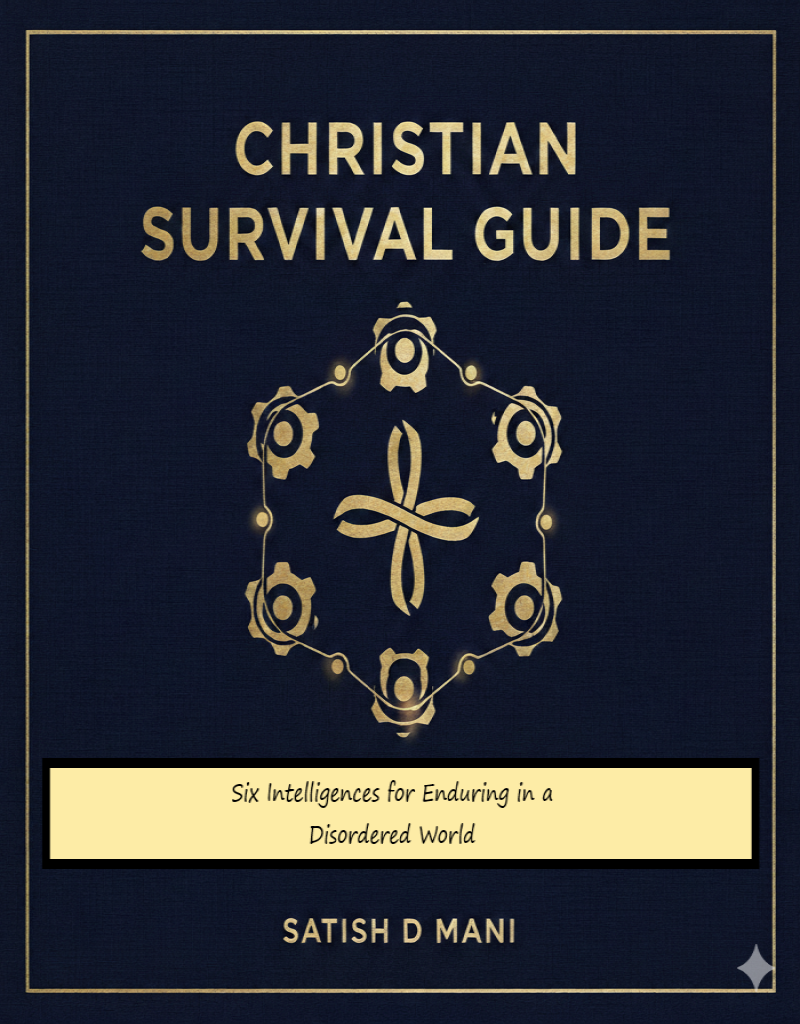
Christian Survival Guide is a practical, clear-eyed roadmap for believers navigating a fractured, noisy, and often hostile world. It moves beyond abstract theology to address the real conditions under which faith must now be lived, tested, and sustained. Organized around six essential intelligences—Emotional, Spiritual, Cognitive, Relational, Moral, and Financial—the book explores how Christians can think clearly, feel honestly, discern wisely, love responsibly, act with integrity, and steward resources without losing freedom or faith. Each section confronts a core vulnerability of modern Christian life: emotional burnout, spiritual manipulation, intellectual confusion, relational breakdown, moral compromise, and financial dependency. Rather than offering formulas or platitudes, the guide emphasizes discernment, discipline, and responsibility. It treats emotions as signals to be governed, spirituality as perception rather than performance, knowledge as a practice of renewed thinking, relationships as covenantal but bounded, morality as costly obedience, and money as a tool rather than a master. This book is written for believers who sense that survival now requires wisdom as much as belief. It speaks to those who want a faith resilient enough to endure pressure, complexity, and change—without hardening the heart or abandoning truth. Christian Survival Guide argues that while salvation secures the soul, wisdom equips the believer to endure the world with clarity, courage, and hope.
Chapters
Part I — Emotional Intelligence
Governing the Inner Life
1. Mastery Without Suppression
Understanding emotions as signals, not masters—how Jesus felt deeply without being ruled by feeling.
2. Fear, Anger, and Desire
How unmanaged emotions become spiritual liabilities—and how they quietly shape decisions, sin, and relationships.
3. Healing Without Bitterness
Trauma, grief, and forgiveness: recovering the heart without hardening it.
Part II — Spiritual Intelligence
Seeing Clearly Before God
4. Discerning the Voice of God
Learning the difference between God’s leading, personal desire, fear, and collective pressure.
5. False Authority and Spiritual Manipulation
Recognizing spiritual abuse, charisma without character, and obedience that God never asked for.
6. Seasons of Silence, Waiting, and Action
Why God sometimes withholds answers—and how misreading seasons leads to burnout or rebellion.
Part III — Cognitive Intelligence
Renewing the Mind
7. Thinking Clearly in a Noisy World
How media, ideology, and outrage hijack attention—and how Christians can reclaim disciplined thought.
8. Truth, Lies, and Bad Theology
Why sincere believers fall into error, and how to test ideas without becoming cynical or arrogant.
9. Learning How to Learn
Humility, curiosity, and mental discipline as spiritual practices in a rapidly changing world.
Part IV — Relational Intelligence
Loving Without Losing Yourself
10. Boundaries, Not Isolation
Why love requires limits—and how boundaryless faith leads to exploitation and exhaustion.
11. Choosing Companions Wisely
Friendship, marriage, and community as destiny-shaping forces.
12. Conflict, Loyalty, and Separation
When to reconcile, when to endure, and when to walk away without guilt.
Part V — Moral Intelligence
Integrity Under Pressure
13. Obedience That Costs Something
Why real obedience always carries a price—and why comfort Christianity collapses under strain.
14. Navigating Gray Areas
Sex, money, power, technology—how to maintain conscience when Scripture is tested by complexity.
15. Courage, Conscience, and Consequence
Standing firm without self-righteousness when truth becomes socially expensive.
Part VI — Financial Intelligence
Stewardship and Freedom
16. Money as a Tool, Not a Master
Understanding wealth without worshiping it, and poverty without romanticizing it.
17. Debt, Dependency, and Control
How financial ignorance limits freedom—and how Scripture views provision and responsibility.
18. Generosity That Sustains, Not Destroys
Giving that honors God and preserves dignity, stability, and future fruitfulness.